Reviews of Daughter Unbound
So very grateful for everyone who has kindly purchased and read my book. Thank you so very much.
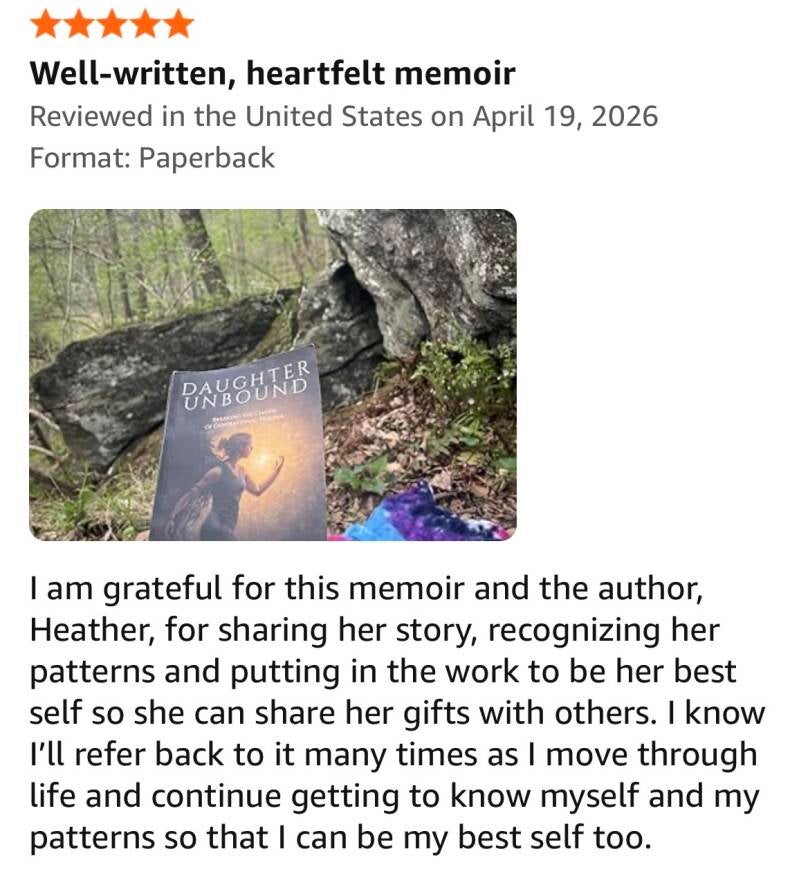
Independent Book Review
*******************************
A reflective exploration of inherited trauma and the difficult work of choosing a different emotional legacy
Daughter Unbound is a memoir in which Heather Jefferson examines her journey toward healing from generational trauma and emotional dysregulation.
The narrative is grounded in her childhood within a volatile home shaped by untreated mental illness, anxiety, and inherited pain, and in her later resolve to create a different emotional environment for her daughters. Key figures include her gentle but emotionally burdened father, her unpredictable mother, her steady older sister, and her husband Bob, whose consistent support becomes a catalyst for change. The book’s primary goal is to document how inherited patterns form, how they are repeated, and how they can be consciously interrupted.
The first half of the memoir focuses on Jefferson’s family history and early life, tracing how trauma moved across generations and manifested in her home through anxiety, anger, and emotional instability. She presents herself as a child who became highly attuned to her parents’ moods, adopting people-pleasing and perfectionism as survival strategies.
One illustrative scene occurs when she describes sitting with her father after drinking to the point of collapse as a young teenager, repeatedly apologizing and begging him not to divorce her mother. The moment captures how she internalized responsibility for her parents’ relationship and reveals the depth of her anxiety and shame at an early age. By the midpoint, the narrative has established how these dynamics shape her identity and why she later recognizes the need for change.
Jefferson’s strength lies in her willingness to portray her family with nuance. Her father is depicted as loving, intellectually curious, and emotionally safe, while still shaped by depression and passivity. Her mother is presented as both creative and volatile, allowing the reader to see how care and harm can coexist within the same person.
Her husband Bob functions as a stabilizing presence whose consistency contrasts with the unpredictability of her childhood and motivates her commitment to change. The memoir is effective in showing psychological development over time. Healing is not framed as a single turning point but as a gradual process of recognizing patterns, naming emotions, and making different choices. Her reflective voice invites the reader to observe this accumulation of insight rather than simply being told that transformation occurred.
The memoir’s strongest through-line is the psychological and relational arc, but this focus is occasionally diluted by extended lists of healing practices that she describes instead of integrating narratively. These sections interrupt the momentum of the story and might have been more effective if anchored to specific moments of change or conflict.
Overall, Daughter Unbound is a hopeful and instructive memoir that documents the slow work of breaking inherited cycles. It will appeal most to readers interested in how family patterns shape identity and how those patterns can be consciously interrupted. Adults reflecting on difficult parental relationships, people-pleasing, anxiety, or inherited shame, and parents attempting to raise children with greater emotional awareness than they received will find particular relevance here.
Because the narrative is reflective and process-driven, it suits readers who value introspection, therapeutic language, and gradual personal growth.
Reviewed by Grace Okubo
Oliver Hartman
"I am a huge reader of memoirs and, as a result, very selective. I want to read honest stories of struggle and triumph and I need to resonate with the writer, even if I don't share their particular travails. This book gave me all I was looking for. Daughter Unbound focuses on generational trauma, a term I think we erroneously associate with prisoners of war, concentration camps, and overt world events. What I think we as a society are still reckoning with is the domestic traumas that take root high up in the family tree and trickle down.
Heather Jefferson tells her story of growing up with all her basic needs met, with two parents who are outwardly functioning yet inwardly scarred and tormented. Not equipped with her parents' stories until she is grown, Heather reacts and behaves as a child from deep pain, shame, and confusion. I so appreciated the "show, don't tell" approach to Heather's exquisite writing. In order to understand the trauma, we need to see it and feel it. The author's gift of storytelling and recalling details let us really feel the atmosphere under which she struggled.
We see Heather grow into a woman, a wife, and a mother, trying to release herself from the patterns of her childhood and cope with her encroaching anxiety. Her journey towards peace is not linear and I loved the true messiness and "andness" with which she laces her recollections. We can be good mothers and also riven with guilt and shame. We can seek peace and in fact be a yogi (as Heather is) and still struggle with overwhelm and dysregulation. I found Heather's journey so relatable and genuine. She is never a victim and she takes accountability for the steps she learns to take in order to free herself from those grasping chains of family trauma.
Loved this book so much and highly recommend!!!"
--Judith
"Dear Heather, I read your book. Wow, what a powerful read and so beautifully written. It brings such joy to my heart that you have fought through this difficult and heart-breaking journey and found deep self and unconditional love. You are an amazing warrior and an inspiration. What a victory for you and your beautiful family. I’m so proud of you and happy for all of you. Thank you for sharing your life journey, struggles, and joys with such openness and honesty. May Dear God continue to bless you, your love-filled family, and all your angels."
--Deb
"I finished this book with a lump in my throat and a profound sense of awe. Writing a memoir is one thing; writing a raw, unflinching account of a troubled and complicated relationship with a mother is quite another. Heather doesn't just tell her story—she displays a rare bravery.
Beyond the subject matter, Heather is a truly gifted writer. Her pacing is perfect, and her ability to build a scene makes you feel like you are standing right there beside her through every obstacle.
This is more than just a memoir; it is a roadmap for anyone who has ever felt defined by their past. It’s a testament to the fact that we can be broken and still build a life that is whole, vibrant, and entirely our own. I am so incredibly proud of her for having the courage to share this light with the world."
--Karen
"The memoir is deeply honest and compassionate, capturing what it truly looks like to grow up carrying emotional responsibility that was never meant for you. By grounding the story in lived experience rather than theory, you give language to a kind of inherited pain many readers feel but struggle to name. What stands out most is the emotional clarity of the journey. You don’t rush healing or oversimplify it. The progression from childhood conditioning, through collapse and reckoning, to embodied practices like yoga and breathwork feels earned and real. The book holds space for grief, estrangement, and anxiety while still offering hope, not as a promise, but as a possibility rooted in self-trust and presence."
--Julie
Daughter Unbound is a deeply personal and moving memoir in which Heather Jefferson chronicles her lifelong struggle with anxiety and her eventual path toward healing and emotional balance. With striking honesty, she explores the painful experiences that shaped her childhood and adolescence, growing up as the daughter of a mentally ill and unpredictable parent.
At the heart of the memoir is the concept of intergenerational trauma. Jefferson thoughtfully traces the roots of her anxiety to a family history marked by abuse, neglect, and untreated mental illness. She illustrates how these patterns can echo across generations, creating a cycle that is difficult to break. Her depiction of life in a home defined by instability—where she was constantly “walking on eggshells”—is both vivid and unsettling, offering readers a clear window into how chronic stress can manifest as deep-seated anxiety and self-doubt.
One of the book’s greatest strengths is Jefferson’s courage in confronting these patterns head-on. She does not shy away from the emotional complexity of setting boundaries with her parents, nor does she minimize the difficulty of disentangling herself from toxic dynamics. Instead, she presents these steps as essential to her recovery, alongside the importance of building a trusted support system of friends and chosen family.
A recurring theme throughout the memoir—“wherever you go, there you are”—underscores the persistence of unresolved trauma. Even as Jefferson builds a loving life as a wife and mother, the underlying tensions in her relationship with her mother continue to affect her well-being. This truth comes to a head years later when she experiences a sudden and debilitating panic attack that disrupts her life and leaves her temporarily unable to function in the world around her.
Rather than marking defeat, this relapse becomes a turning point. Jefferson’s account of this period is particularly powerful, as she describes the physical and emotional intensity of her symptoms with clarity and vulnerability. From this low point emerges a transformative journey, grounded in practices such as meditation and yoga, which become central to her healing process. Through these tools, she gradually moves from mere survival toward self-awareness, resilience, and ultimately, a sense of peace.
Daughter Unbound is both comforting and inspiring. Jefferson’s willingness to “peel back the layers” and share her most vulnerable moments makes her story deeply relatable. For readers struggling with anxiety—or grappling with the lingering effects of family trauma—this memoir offers reassurance that healing is possible, even after setbacks. It is a testament to the strength required to confront one’s past and the hope that can emerge from doing so.
--Ann
"When I started reading “Daughter Unbound," a memoir by Heather Jefferson, I didn’t think I would still be reading it four hours later. I only put it down because I needed to sleep. When I finished it the next morning, my heart was full of both tremendous sadness and great hope for a brave and tenacious woman. Heather shows true grace when she acknowledges the reasons for the abuse, but is honest about the details and the damage. I found myself saying out loud, “Oh no, no no no” as she describes all she and her family endured, and then saying, “Oh wow” as she fights for her health, her heart and her family.
Her story should be read by everyone, regardless of their childhood. Those who have struggled in similar circumstances will find inspiration to find a path towards healing, and others will simply be greatly moved by the story. Additionally, it will give everyone a better understanding of the importance of showing compassion for others, recognizing that we never know a person's full story."
--Allison
"Spoiler alert.
Daughter Unbound was written by my dear friend Heather Jefferson. So I know that I do not seem like a reliable source for a review of her memoir. But please believe me when I tell you that is a compelling, honest, heartfelt, painful and beautiful description of Heather’s lifelong journey with a mother that was very often not loving, nurturing, generous or motherly.
Heather struggles to figure out how she fits into a world where she has grown up being blamed by her mother. Blamed for the difficulties in her parents’ marriage, her mother’s depression and unhappiness, and often just blamed as an excuse for her mother to vent her anger. But Heather thrives. As a wife, a mother, a friend, an inspirational yoga teacher and a writer.
Following along on Heather’s journey as she struggles and learns to overcome her rollercoaster relationship with her unpredictable and often cruel mother is spellbinding. Heather’s journey to healing is impressive and powerful. Though the subject matter is heavy, Heather’s optimism shines through.
The book is hard to put down."
--Susan
"This memoir is deeply honest and compassionate, capturing what it truly looks like to grow up carrying emotional responsibility that was never meant for a child. By grounding the story in lived experience rather than theory, the author gives language to a kind of inherited pain many readers feel but struggle to name.
What stands out most is the emotional clarity of the journey. Nothing is rushed or oversimplified. The progression from childhood conditioning, through collapse and reckoning, to embodied practices like yoga and breathwork feels earned and real. The book holds space for grief, estrangement, and anxiety while still offering hope, not as a promise, but as a possibility rooted in self-trust and presence."
--Melissa
"Daughter Unbound is a gripping, heartfelt memoir that gets to the crux of how our forebears can influence our outer and inner lives. How do we cope with these secondary inflictions? The author takes us down her long, complicated journey through pain and anxiety toward peace and fulfillment that only comes via self-reflection and doing the work necessary to self-heal. Every reader can benefit from some portion of Heather’s tale and take a road that perhaps would have gone untraveled otherwise. Read this book for yourself and for your children."
--Bob
"I spent time with Daughter Unbound, and what stayed with me most was the courage it takes not just to survive generational trauma, but to consciously interrupt it. This doesn’t read as a memoir driven by exposition or explanation. It feels lived-in and honest, a reckoning with the invisible roles daughters inherit and the cost of carrying pain that was never truly theirs."
--Grace